
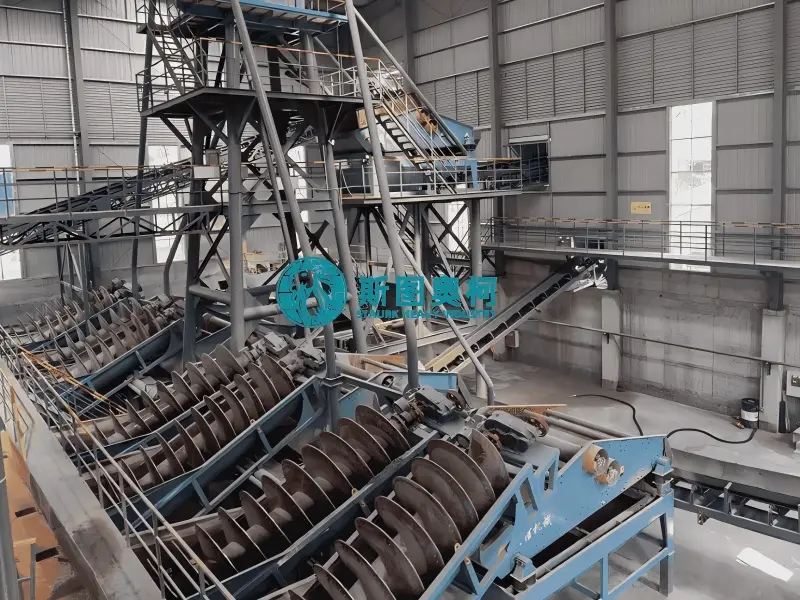
Screw sand washers are among the most widely used equipment in quartz sand washing and classification. They separate quartz sand from clay, slime, and light impurities through the agitation and conveying action of spiral blades. However, in practical selection, many users easily fall into misconceptions—either believing "bigger is better" or focusing solely on price. This often leads to insufficient production capacity or excessive operating costs once the equipment is put into operation. The key selection points are systematically outlined below across five sections.
Section 1: Define Your Needs
Before purchasing a screw sand washer for quartz sand, three core questions must be addressed:
Washing Goal: What level of finished product quality do you aim to achieve? Is it for standard construction/casting sand, or high-purity applications such as glassmaking, photovoltaics, or electronic-grade quartz sand with strict purity and iron-content requirements? This directly determines the required washing intensity and material contact requirements.
Site Conditions: Is your existing production line layout compact, or is there sufficient space? Screw sand washers feature a horizontal trough structure, making them longer and requiring a larger footprint than bucket-wheel sand washers.
Budget Range: A balance must be struck between initial investment and long-term operating costs. Double-spiral equipment comes at a higher price and consumes more energy, but it offers significantly higher agitation intensity and scrubbing performance for quartz purification.
Section 2: Understand Material Characteristics
The characteristics of quartz sand directly influence equipment selection, with two key parameters requiring careful evaluation:
Clay and Impurity Content: If the clay or slime content in quartz sand is below 10%, a single-spiral sand washer is fully capable. However, if the clay content exceeds 15%, includes sticky clayish components, or requires severe surface scrubbing to remove attached impurities, a double-screw washer is required to provide more thorough washing and attrition.
Feed Size: Screw washers typically require a feed particle size below 10 mm (and often much finer for specialized quartz processing, such as $0.1 \sim 1 \text{ mm}$). If the raw quartz material contains larger lump ore or un-crushed gravel, screening or crushing equipment must be installed upstream to prevent damage to the spiral blades.
Section 3: Confirm Capacity and Equipment Dimensions
Confirming capacity and equipment dimensions is the most critical step in selection. The core logic is not "how wide should it be?" but rather "what throughput capacity does my required output demand?"
The processing capacity of a spiral sand washer is primarily determined by the spiral diameter and trough length:
Spiral Diameter: A larger diameter allows the blades to push a greater volume of material, setting the physical upper limit of throughput.
Trough Length: The trough length determines the retention time of the material inside the washing tank—longer retention time allows for more thorough separation of fine clay and slime from quartz grains.
For quartz sand washing, every 5% increase in clay/slime content requires a corresponding extension in washing time; otherwise, the purity and turbidity standards of the discharged quartz sand may not be met. The continuity of material feeding must also be considered: if upstream feeding is uneven, the machine cannot perform to its full capability, regardless of its size.
The correct selection approach is to first establish the target hourly output, calculate the required range of spiral diameters, and reserve at least a 20% margin to accommodate fluctuations in clay content and raw ore quality. Avoid blindly chasing oversized equipment; overly large machinery not only incurs higher upfront investment but also reduces washing efficiency when output is insufficient due to excessively thin material layers—resulting in an inefficient "overpowered" operating state. The ideal choice fulfills production demands while remaining as compact in size and economical in operating costs as possible.
Section 4: Select Compatible Equipment Components & Understand Working Principles
After clarifying requirements and production capacity, attention should be directed to the core configuration and operating principles.
Working Principle
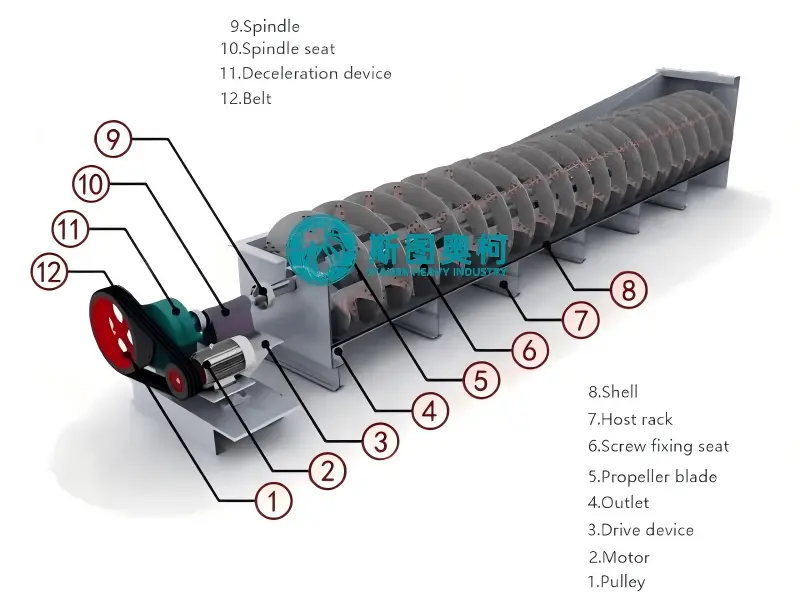
During operation, the motor drives the spiral shaft to rotate via a speed reducer. Quartz sand enters the trough from the feed end and, under the agitating action of the spiral blades, continuously tumbles and rubs together to scrub away attached clay and impurities from the silica grains. Meanwhile, water is continuously added to create a flow that carries fine clay powder, silt, and light impurities out through the overflow port. The cleaned quartz sand is pushed by the spiral blades and discharged from the outlet end.
Key Component Selection Points
Single Spiral vs. Double Spiral: Single-spiral models suit small-to-medium production lines, offering high cost-effectiveness and simple maintenance. Double-spiral models deliver higher scrubbing intensity, making them ideal for high-clay quartz sand or applications requiring higher silica purity.
Spiral Blade & Trough Material: Because quartz is extremely abrasive (Mohs hardness ~7), wear resistance is paramount. High wear-resistant alloys, polyurethane (PU), or rubber liners are strongly recommended. Polyurethane or rubber linings also prevent iron contamination, which is critical for high-purity glass and electronic-grade quartz sand.
Sealing Structure: The bearing positions must feature heavy-duty, multi-stage sealing (such as rubber seals and oil seals) to prevent abrasive quartz slurry intrusion from causing premature shaft or bearing failure.
Section 5: Summary
Selecting a screw sand washer for quartz sand ultimately comes down to accurately matching production requirements, material characteristics, and equipment performance. It is recommended to proceed with decision-making in the following order:
Define target output and finished product purity standards (e.g., iron content and mesh size).
Test the clay content and feed particle size of the raw quartz sand.
Choose between a single-spiral or double-spiral model based on these parameters.
Match appropriate equipment specifications, anti-contamination linings, and wear-resistant components.
Always leave an adequate margin above theoretical capacity during selection to handle fluctuations in raw ore and avoid bottlenecks during peak seasons. A systematic and forward-looking selection strategy ensures the equipment maintains high efficiency, durability, and product purity throughout long-term operation.