
A rotary drum dryer for kaolin drying is essential equipment for dewatering kaolin clay in industries such as ceramics, papermaking, and coatings. When selecting this type of equipment, factors such as kaolin's high moisture content and its tendency to shrink and deform when heated must be considered to match the appropriate drum size, heat source temperature, and internal lifter (lifting flight) structure. Henan Staurk Machinery Co.,Ltd is here to design the optimal solution for you.
Define the Drying Requirement
First, determine production capacity targets and end-use applications. Kaolin is widely used in ceramics, papermaking, coatings, and refractories, with different applications imposing varying requirements on final moisture content. For instance, ceramic bodies require high moisture uniformity; excessive drying shrinkage can easily lead to deformation or cracking. Additionally, identify the available heat source type—high-temperature hot-blast stoves (700–800°C) are suitable for direct-heating rotary drum dryers, which are appropriate for materials that do not require stringent hot-air purity standards.
Understand the sawdust and Its Moisture Condition
Kaolin is a clay rock composed primarily of kaolinite-group minerals, characterized by water absorption, plasticity, and adhesiveness. Its initial moisture content typically ranges from 40% to 60% or even higher. A critical factor to note is that kaolin begins to dehydrate at temperatures between 40°C and 60°C; as moisture is expelled, the distance between particles decreases, causing volumetric shrinkage. This characteristic necessitates careful control of the heating rate and temperature distribution during drying to prevent uneven shrinkage caused by localized overheating. Furthermore, kaolin is prone to agglomeration or sticking to the drum walls; selecting equipment with self-cleaning capabilities can effectively mitigate this issue.
Confirm the Capacity and Drum Size
Determining production capacity and drum dimensions is essentially a matter of finding the right balance between kaolin's moisture content and the required throughput. The drum diameter determines the width at which material spreads across the cross-section, serving as the basis for the equipment's hourly processing capacity; meanwhile, the drum length directly dictates the material's residence time within the drum—that is, the total duration of heat exchange between the hot air and the material. For materials like kaolin—which have high initial moisture content and undergo significant shrinkage during drying—insufficient diameter limits throughput, while insufficient length prevents adequate moisture evaporation, resulting in a product that fails to meet specifications. Equipment selection requires a coordinated analysis of target output, feed moisture, and final moisture content. The core logic involves first calculating the required hourly evaporation rate, then determining the necessary drum volume based on this evaporation load, and finally selecting an optimal combination of diameter and length to ensure both sufficient production capacity and effective drying.
Select the Matching Equipment
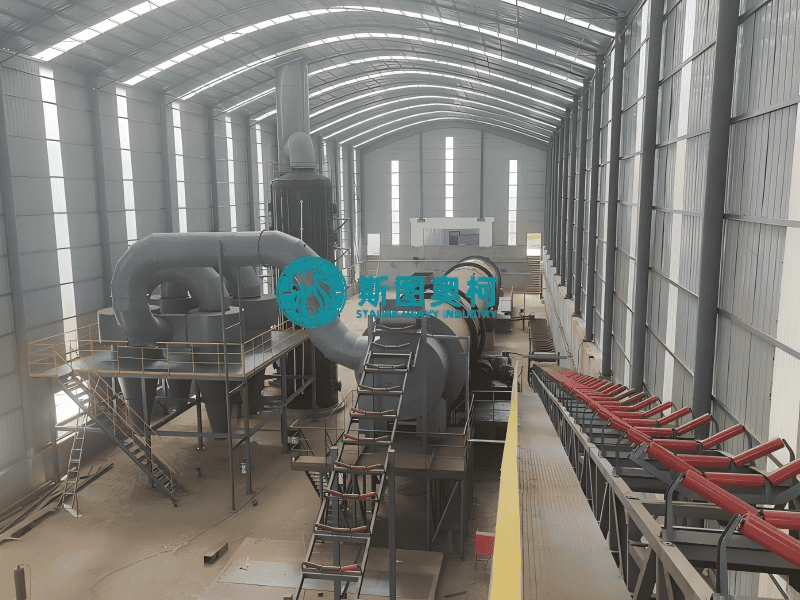
Once requirements and output targets are defined, attention should be focused on the following key configuration elements: First is the heat source temperature; kaolin drying typically employs high-temperature hot air (700–800°C) for rapid drying, though the heating rate must be controlled to prevent uneven shrinkage. Second is the design of the lifting flights (lifters); a multi-combination lifting system ensures kaolin is evenly distributed across the drum's radial cross-section, maximizing contact area with the hot air and enhancing drying efficiency. Regarding the drive system, replaceable pin-type gears offer easier maintenance and lower costs compared to traditional cast-steel gears. Additionally, the equipment is typically installed at a 3–5% slope—with the feed end higher than the discharge end—utilizing gravity to assist material movement toward the discharge end.
How a Kaolin Rotary Drum Dryer Works
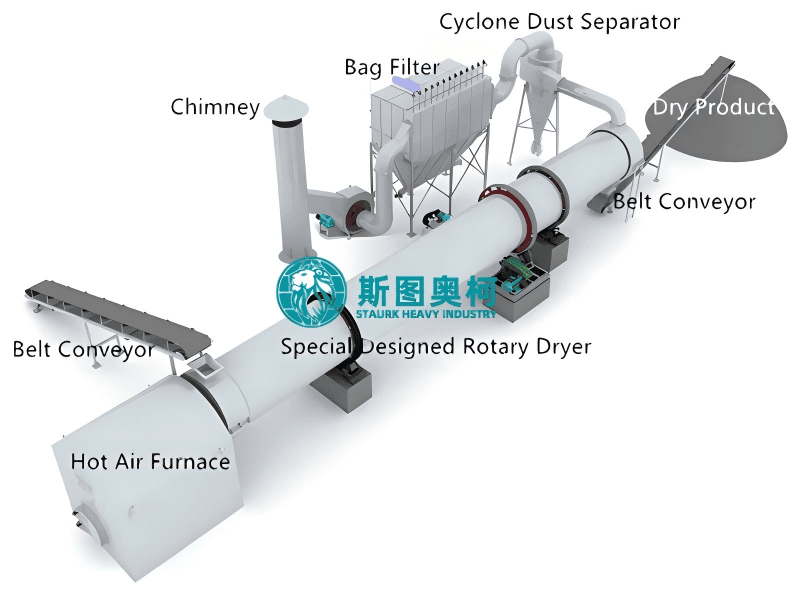
The core of the Rotary Drum Dryer for Kaolin Clay is a cylindrical drum installed at a slight incline of 3–5° relative to the horizontal.Kaolin is fed into the higher end, while hot air (700–800°C) enters the drum from either the same end or the opposite end. As the drum rotates, internal lifting flights continuously scoop up and shower down the kaolin, creating a uniform "material curtain" that ensures full contact between the material and the hot air, thereby accelerating moisture evaporation. Simultaneously, gravity causes the kaolin to move slowly toward the lower end. The drum is often equipped with breaking devices that shatter material clumps formed during the falling process into fine particles, further increasing the specific surface area. The dried kaolin is discharged from the bottom end, while the water-vapor-laden exhaust gas is purified by a dust removal system before being vented. Both ends of the equipment feature a high-sealing design, balancing energy efficiency with environmental protection.
Conclusion
Key considerations for selecting a rotary drum dryer for kaolin include: accounting for kaolin's high water absorption and tendency to shrink or deform upon heating by controlling temperature distribution to prevent localized overheating; matching the drum diameter and length to production targets while incorporating a capacity margin of over 20%; selecting a multi-combination lifting flight configuration to enhance drying uniformity and minimize wall adhesion and agglomeration; and maintaining the heat source temperature between 700°C and 800°C to ensure rapid drying while balancing energy consumption. A systematic approach to equipment selection is essential to ensure long-term, stable, and efficient operation.