
Selecting a rotary drum dryer for coal drying involves more than confirming the required hourly capacity. Coal type, particle size, moisture content, heat source and operating conditions all affect the final equipment configuration.
At Staurk, we select the dryer according to the actual material and production requirements. The goal is to achieve stable final moisture, reasonable energy consumption and reliable long-term operation.
Define the Drying Requirement
The selection process should begin with the actual purpose of the drying line.
Feed capacity is important, but it does not fully represent the drying load. The initial moisture, target moisture, daily operating time and final use of the coal should also be confirmed.
Coal prepared for storage may have different requirements from coal used for combustion, briquetting or further processing. Available fuel, plant space and local emission requirements will also influence the heat source, dust collection system and overall layout.
For this reason, Staurk evaluates the complete production condition before recommending a dryer model.
Understand the Coal and Its Moisture Condition
Coal properties directly affect the drying process.
Fine coal usually dries faster, but it may generate more dust. Larger particles require longer heat exchange time. Wet and sticky coal may accumulate near the feeding end or adhere to the internal lifting structure.
Initial and final moisture determine the amount of water that must be removed. The moisture measurement method should also be confirmed to avoid incorrect calculations.
In one project, the required feed capacity was 100 tons per hour, with moisture reduced from 35% to below 30%. Under these conditions, the system needs to evaporate approximately 7 tons of water per hour.
This evaporation load is an important basis for calculating heat input, airflow and dryer size.
Confirm the Capacity and Drum Size
After confirming the material properties and evaporation requirement, the drum diameter and length can be selected.
The drum diameter affects the material handling capacity and hot air flow. The drum length affects the residence time and available heat exchange period.
However, diameter and length cannot be considered separately. Drum speed, inclination, lifting flight design and drying temperature also affect the final performance.
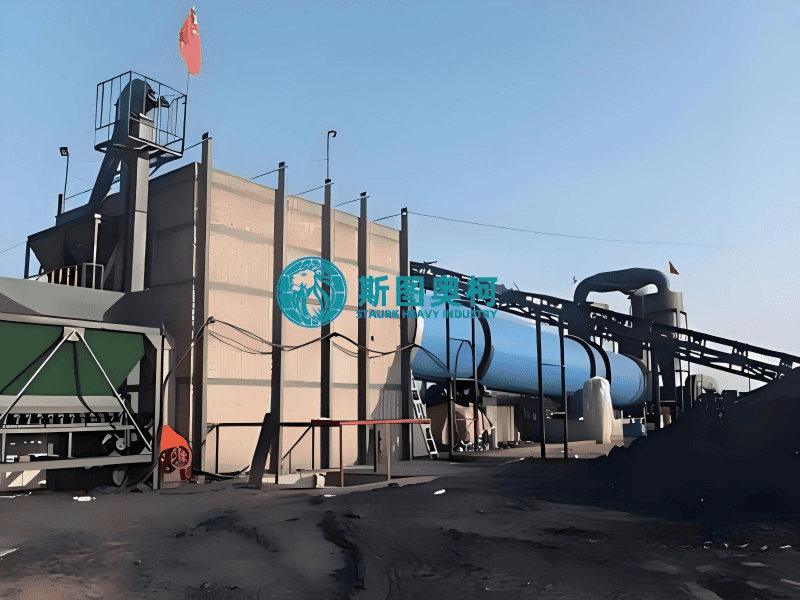
For the project described above, Staurk proposed a Φ3.0 × 20 m rotary drum dryer as the main drying unit.
This model can be used as a project reference, but it is not a standard solution for every 100 t/h coal drying line. Changes in particle size, moisture, bulk density or heat source may require a different configuration.
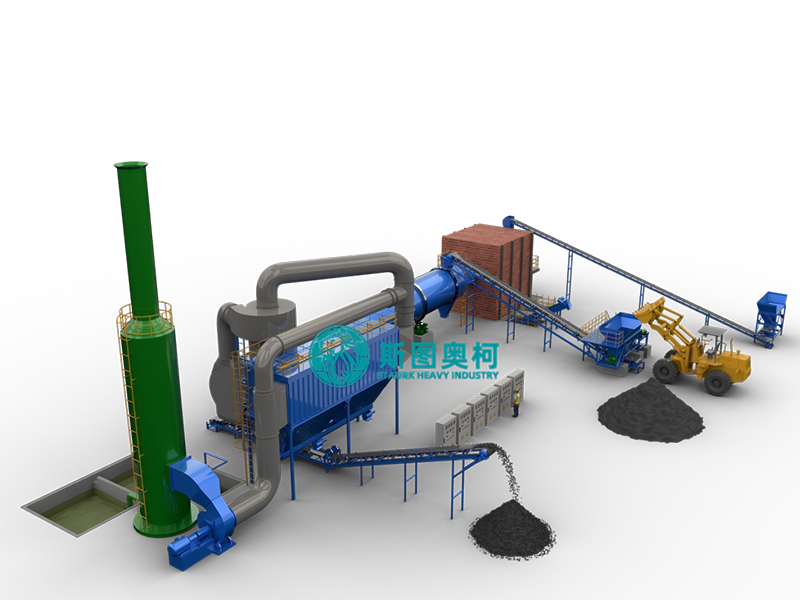
Select the Matching Equipment
A complete coal drying line includes more than the rotary drum.
The feeding system must deliver wet coal continuously and evenly. Unstable feeding may cause fluctuations in outlet moisture and temperature.
The heat source should provide stable and adjustable hot air. Depending on local fuel conditions, the system may use a coal-fired furnace, gas burner, biomass furnace or another heating method.
Inside the drum, lifting flights raise and scatter the coal through the hot air. Their design should match the particle size, moisture and flowability of the material.
The transmission system, support rollers, induced draft fan and dust collector must also match the dryer capacity. Temperature monitoring and suitable fire or explosion prevention measures should be included according to the coal properties and local regulations.
At Staurk, the dryer and supporting equipment are designed as one complete system rather than selected independently.
How a Coal Rotary Drum Dryer Works
Wet coal enters the slightly inclined rotary drum through the feeding system.
As the drum rotates, the internal lifting flights raise the coal and allow it to fall through the hot air. This forms a material curtain and increases the contact area between the coal and the drying gas.
The material gradually moves toward the discharge end while moisture evaporates. The dried coal is discharged for storage or further processing.
Moisture-laden exhaust gas is drawn out by the induced draft fan and then enters the dust collection system.
During operation, the feeding rate, hot air temperature, airflow and drum speed must remain balanced. Stable control is more important than simply increasing the drying temperature.
Conclusion
Choosing a rotary drum dryer for coal drying should begin with the material and the actual production requirement.
Coal type, particle size, feed capacity, initial moisture and target moisture determine the drying load. These conditions are then used to select the drum size, internal structure and supporting equipment.
For the referenced project, Staurk selected a Φ3.0 × 20 m rotary drum dryer for a capacity of 100 tons per hour and a moisture reduction from 35% to below 30%.
Before confirming a coal drying solution, Staurk reviews the material data, available fuel and site conditions to provide a suitable equipment configuration. A correctly selected system should provide stable moisture control, reasonable fuel consumption and reliable operation.