
What Is a Rotary Kiln?
A rotary kiln is an inclined, constant-speed rotating calcination and roasting equipment used widely across various heavy industries for high-temperature processing. It is a highly complex thermal system subjected to mechanical stress, thermal deformation, and chemical corrosion. Driven by the constant rotation and natural gravity of the kiln, raw materials enter the vertical preheater from the feeding system and uniformly increase in temperature to complete the necessary physical and chemical changes.
How Does a Rotary Kiln Work?
A rotary kiln is a complex thermal equipment subjected to mechanical stress, thermal deformation, and chemical corrosion. The shell is inclined and supported by 3 riding rings. Driven by the main motor and open gear system, the kiln rotates slowly. Materials enter from the kiln tail, tumbling circumferentially and moving axially. Fuel is injected from the kiln head, and combustion exhaust gases exchange heat with the materials before exiting the tail. The clinker drops into the cooler.
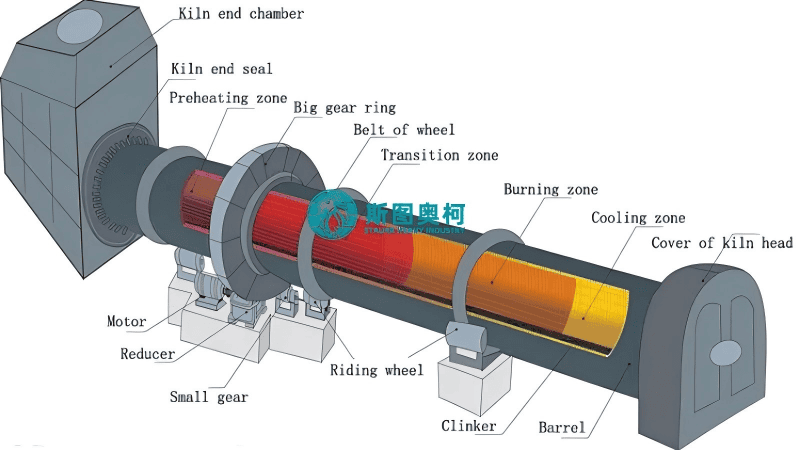
The calcination process includes three stages
- Preheating Stage:Materials gradually heat up, releasing moisture and volatiles.
- Calcination Stage:The highest temperature zone where fuel combustion creates a high-temperature flame, causing chemical reactions to form new compounds (e.g., cement clinker).
- Cooling Stage:Calcined materials exchange heat with circulating external cooling air, rapidly dropping in temperature while improving energy efficiency.
Main Components of a Rotary Kiln
- Shell and Kiln Lining: The main body is a steel cylinder ranging from 30 to 150 meters long. Because internal temperatures can exceed 1450 degrees Celsius, it is internally lined with refractory materials to withstand immense heat and protect the outer steel. It is divided into drying, preheating, decomposition, calcination, and cooling zones.
- Support Devices:The shell's massive weight is transferred via cast steel riding rings (tyres) to the support rollers. A pair of symmetrical support rollers (installed at a 60-degree angle) supports each riding ring, allowing smooth rotation.
- Drive Device: Consists of a main motor, gear reducer, and coupling. A pinion gear drives a girth gear mounted on the shell. Auxiliary drives are also included to rotate the kiln at extremely low speeds for maintenance.
- Burner and Kiln Hood:Burners inject fuel (coal, oil, or gas) from the kiln hood end to heat materials via flame radiation.
- Additional Systems:These include internal heat exchanger chains to enhance heat transfer, a cold smoke chamber for exhaust gas extraction, stable feeding devices, and various sealing devices (labyrinth, contact, packing, or pneumatic) to maintain negative pressure and prevent heat loss.
Key Structural Mechanics and Adjustments
- The operational rate and lifespan of a rotary kiln heavily depend on protecting the refractory brick lining. This requires minimizing the shell's radial deformation and managing thermal expansion, which causes the steel shell to expand in both length and diameter due to high internal temperatures.
- Axial drifting is another critical operational factor. Because the kiln is installed on foundations at a 2.5% to 5% downward incline, a circumferential force causes "elastic sliding" during rotation, moving the kiln downward. To prevent excessive wear, operators can intentionally skew the support rollers. This intentional skewing creates an upward "spiral effect" that directly balances the downward sliding speed. Maintenance of this drifting requires exact precision, adjusting the roller base in tiny increments of 0.2 to 0.35 mm while running at a low speed of 1 rpm, and carefully monitoring bearing oil temperatures to avoid critical overheating and mechanical trips. Additionally, hydraulic thrust rollers actively manage axial movement by pushing the kiln upward and letting it drift down several times a day.
- Ultimately, kiln designs vary based on processing needs: cement kilns rely on natural inclines, lime kilns feature compact layouts, and bauxite kilns focus on uniform heating properties. All function as heavy-duty equipment transforming raw material into essential compounds, ensuring consistent production output and operational stability across various demanding industrial and chemical environments.
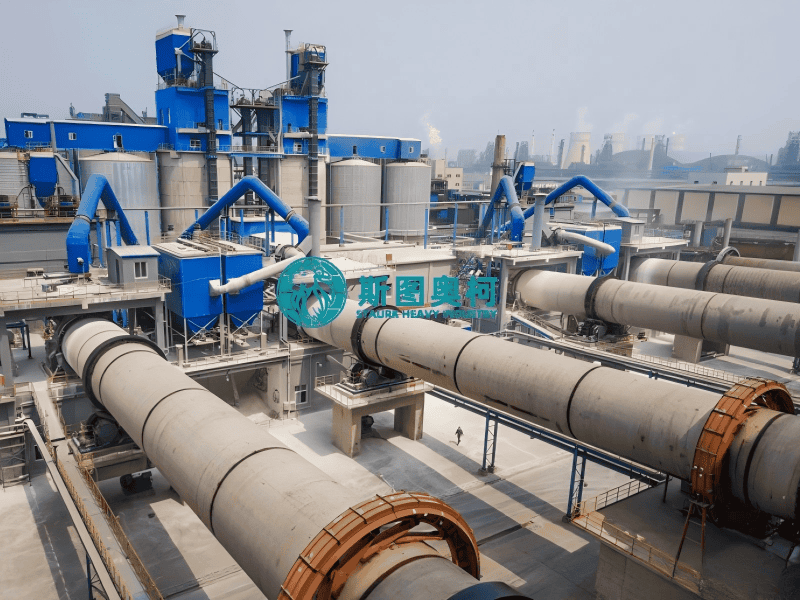
Looking for a reliable rotary kiln solution?
Staurk provides customized rotary kiln equipment and complete calcination solutions based on material characteristics, production capacity, target temperature, fuel type, and final product requirements. Contact the Staurk engineering team for equipment selection, process design, and quotation support.