
A rotary drum dryer is a continuous industrial drying machine used to reduce the moisture content of bulk materials. It is commonly applied to sand, minerals, coal, clay, fertilizer, biomass, sludge, chemicals, and other materials that require stable and large-scale drying.
Compared with small batch drying equipment, an industrial rotary dryer can handle larger production capacities while maintaining continuous operation. Its relatively simple mechanical structure also makes it suitable for mining plants, mineral processing facilities, building material factories, fertilizer plants, and waste treatment projects.
This article explains the rotary drum dryer working principle, main structural components, common configurations, operating parameters, and industrial applications.
How Does a Rotary Drum Dryer Work?
The basic working principle of a rotary drum dryer is to bring wet material into continuous contact with a controlled stream of hot gas.
The drying process usually includes feeding, lifting, heat transfer, material movement, discharging, and exhaust gas treatment.
Wet material first enters the slightly inclined rotating drum through a belt conveyor, screw conveyor, chute, or rotary feeding valve. The feeding system should maintain a relatively stable flow because large fluctuations in feed rate can affect the outlet moisture and drying temperature.
Inside the drum, specially designed lifting plates pick up the material as the shell rotates. The lifted material then falls through the hot gas stream, forming a moving material curtain. This repeated lifting and showering action increases the contact area between the material and hot air.
As the material travels through the drum, heat is transferred from the gas to the wet material. Moisture inside the material evaporates and leaves the dryer with the exhaust gas.
The drum is normally installed at a small inclination, commonly between approximately 1° and 5°. The combination of drum rotation, internal flights, gravity, and airflow gradually moves the material toward the discharge end.
After drying, the material is collected through a discharge hood or valve. Moisture-laden exhaust gas is normally treated by a cyclone separator, bag filter, wet scrubber, or a combined dust collection system before being discharged.
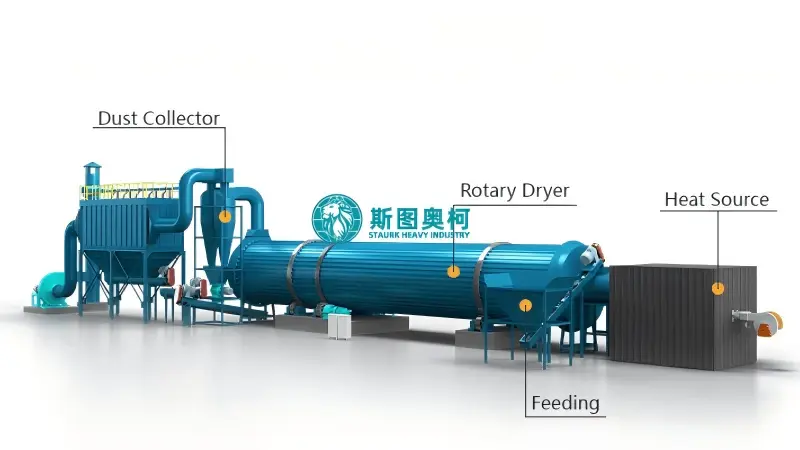
Main Structure of a Rotary Drum Dryer
Although rotary dryers can be customized for different materials, most systems contain several common structural components.
Rotary Drum Shell
The drum shell is the main cylindrical body of the dryer. It is generally manufactured from carbon steel, stainless steel, or heat-resistant steel, depending on the operating temperature and material characteristics.
For abrasive materials such as silica sand, mineral concentrate, slag, or ore, wear-resistant liners may be installed in high-wear areas.
Internal Lifting Flights
Lifting flights, also called lifters, are installed along the inner wall of the drum. Their purpose is to lift, distribute, and shower the material through the hot gas stream.
The shape and arrangement of the flights should be selected according to the material size, moisture, density, stickiness, and flowability. Common designs include L-shaped flights, angled flights, distribution plates, and combination lifting systems.
Proper flight design is important because insufficient material dispersion can reduce drying efficiency, while excessive lifting may increase dust entrainment.
Riding Rings and Supporting Rollers
Large steel riding rings are installed around the drum shell and supported by trunnion rollers. These components carry the weight of the rotating drum and maintain stable rotation.
The supporting system must be correctly aligned to prevent uneven loading, vibration, premature roller wear, and shell deformation.
Drive System
The drive system usually includes an electric motor, coupling, gearbox, pinion, and girth gear. It supplies the torque required to rotate the drum at a controlled speed.
The rotational speed is generally low, but it has a direct influence on material lifting, residence time, and discharge stability.
Thrust Rollers
Because the drum is installed at an inclination, axial force is generated during operation. Thrust rollers control the axial position of the drum and prevent excessive movement along the supporting rollers.
Inlet and Outlet Seals
Sealing devices are installed between the rotating drum and the stationary inlet and outlet hoods. They help reduce hot gas leakage and prevent uncontrolled cold air from entering the drying system.
Good sealing improves thermal efficiency and makes airflow control more stable.
Hot Air and Exhaust System
A complete rotary drum drying system may include a hot air furnace, burner, combustion chamber, forced draft fan, induced draft fan, ductwork, dust collector, and chimney.
Available heat sources may include natural gas, diesel, coal, biomass, electricity, steam, or industrial waste heat.
Common Types of Rotary Drum Dryers
Rotary dryers can be classified by airflow direction, heating method, and drum configuration.
Co-Current Rotary Dryer
In a co-current dryer, the wet material and hot gas move in the same direction.
The wettest material contacts the highest-temperature gas near the inlet. Because moisture evaporation provides a cooling effect, this configuration can be suitable for high-moisture materials and some temperature-sensitive products.
Co-current drying is also commonly used when a lower material discharge temperature is required.
Counter-Current Rotary Dryer
In a counter-current dryer, the material and hot gas move in opposite directions.
The driest material contacts the hottest gas near the discharge end. This arrangement can provide high thermal efficiency and may help achieve lower final moisture.
However, it should be evaluated carefully for heat-sensitive materials because the dried product is exposed to relatively high temperatures before discharge.
Direct-Heated Rotary Dryer
A direct rotary dryer allows hot air or flue gas to contact the material directly. This is the most common configuration because it provides efficient heat transfer and supports high production capacity.
Direct drying is widely used for sand, minerals, clay, coal, fertilizer, slag, and many other bulk materials.
Indirect-Heated Rotary Dryer
In an indirect dryer, the heating medium does not directly contact the material. Heat is transferred through the drum wall, internal tubes, or another heat exchange surface.
This configuration may be selected for high-purity, toxic, flammable, reactive, or easily contaminated materials. However, indirect dryers usually have a more complex structure and may require a larger heat transfer area.
Single-Pass and Triple-Pass Dryers
A single-pass rotary dryer uses one main cylindrical drum and is suitable for a wide range of industrial materials.
A triple-pass dryer contains several concentric cylinders. The material passes through the dryer multiple times, providing a longer drying path within a relatively compact footprint.
Triple-pass designs are often used for lightweight materials such as biomass, sawdust, wood chips, and some agricultural products. They are not automatically the best option for every abrasive, sticky, or large-particle material.
Important Rotary Dryer Operating Parameters
The performance of a rotary drum dryer depends on more than the inlet temperature. Several parameters must be balanced together.
Feed Moisture and Final Moisture
The initial moisture content determines how much water must be evaporated. The target outlet moisture then affects the required heat input, drum size, airflow, and residence time.
A dryer designed to reduce moisture from 20% to 10% may be very different from a system designed to reduce moisture from 50% to below 5%.
Material Size and Flowability
Particle size, bulk density, stickiness, and abrasion influence the feeding system, flight design, drum speed, and dust collection configuration.
Sticky sludge or filter cake may require a dispersion device, back-mixing system, crusher, or specially designed flights to prevent buildup inside the drum.
Inlet and Outlet Temperature
The inlet gas temperature must provide enough heat for evaporation without damaging the material.
The outlet temperature is also an important operating indicator. Sudden changes in outlet temperature may indicate unstable feeding, excessive airflow, burner problems, or changes in material moisture.
Air Volume and Gas Velocity
Airflow must be sufficient to carry evaporated moisture out of the dryer. However, excessive gas velocity may increase dust entrainment and product loss.
The induced draft fan and duct system should therefore be selected together with the drum diameter and dust collection equipment.
Drum Speed, Inclination, and Residence Time
Drum speed and inclination influence how long the material remains inside the dryer.
A shorter residence time may lead to incomplete drying, while excessive retention can increase energy consumption, product temperature, and equipment wear.
Industrial Applications
Rotary drum dryers are used across many industries because they can process materials with different particle sizes, moisture levels, and production capacities.
Typical applications include:
- Silica sand, river sand, foundry sand, and construction sand
- Iron ore, copper concentrate, gold ore concentrate, and other minerals
- Coal, lignite, coke, and coal slime
- Clay, bentonite, gypsum, limestone, and cement raw materials
- Organic fertilizer and compound fertilizer
- Slag, fly ash, and industrial byproducts
- Municipal sludge and industrial sludge
- Sawdust, wood chips, biomass, and agricultural residues
- Chemical powders, crystals, and granules
For food, feed, pharmaceutical, or high-purity chemical applications, the material-contact components, heat source, temperature control, and contamination requirements must be evaluated separately.
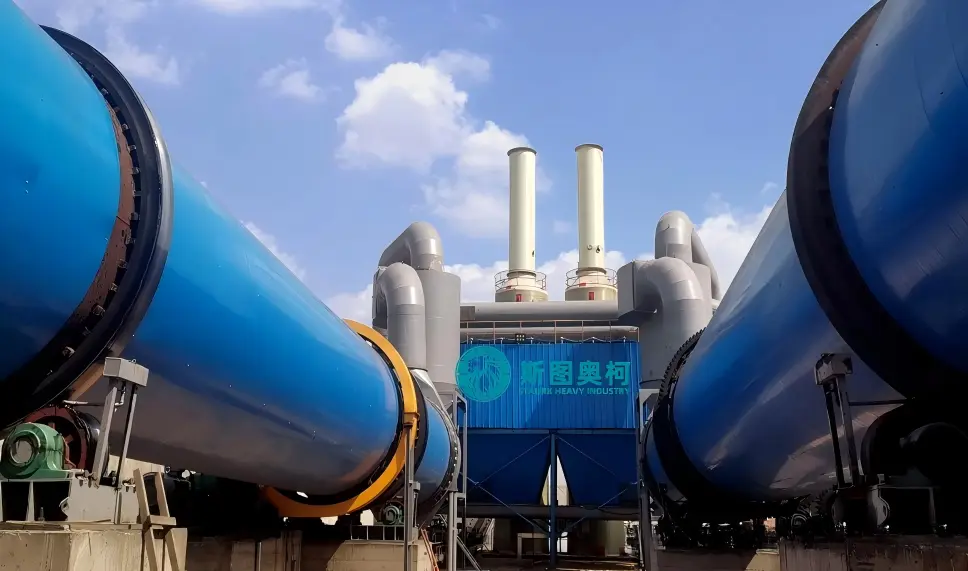
How to Select a Rotary Drum Dryer
Before selecting an industrial rotary dryer, the supplier should understand the actual material and process conditions rather than relying only on the required production capacity.
The most important information includes:
- Material name and composition
- Initial moisture content
- Required final moisture
- Hourly wet feed capacity
- Particle size and bulk density
- Material stickiness and abrasiveness
- Maximum allowable product temperature
- Available fuel or heat source
- Local dust and emission requirements
- Installation space and site conditions
At Staurk, rotary drum dryer selection normally starts with the material data and moisture balance. The drum diameter, drum length, heating method, airflow arrangement, flight design, burner capacity, and dust collection system are then configured according to the required drying result.
For materials with uncertain properties, drying tests or representative sample analysis can reduce the risk of selecting an unsuitable dryer configuration.
Maintenance and Safety
Regular inspection is necessary to maintain stable rotary dryer operation.
Supporting rollers, riding rings, gears, bearings, and reducers should be lubricated according to the maintenance schedule. Drum alignment, gear contact, seal wear, vibration, and shell condition should also be checked periodically.
For combustible dust, biomass, coal, or flammable materials, the drying system may require temperature interlocks, spark detection, explosion relief, oxygen monitoring, fire suppression, or inert gas protection.
Operators should follow the correct startup and shutdown sequence. During inspection or repair, the dryer and all connected feeding, burner, fan, and conveying equipment should be isolated using appropriate lockout and tagout procedures.
Conclusion
The rotary drum dryer working principle is based on continuous material movement, repeated lifting, and direct or indirect heat transfer inside a rotating cylindrical shell.
However, drying performance depends heavily on material properties, moisture reduction, airflow, heat source, residence time, internal flight design, and exhaust treatment. A standard dryer configuration cannot provide the same result for every material.
Staurk supplies rotary drum drying systems for minerals, sand, coal, clay, fertilizer, sludge, biomass, and other industrial materials. Providing accurate material and capacity information before equipment selection helps determine a more suitable and energy-efficient drying solution.