
When Fly Ash Becomes a Handling Problem
Fly ash is widely used in cement, concrete, bricks, blocks, road base materials, and other building material applications. In many projects, the material is not difficult because of its composition alone, but because of its moisture condition and handling behavior.
Fly ash collected from storage ponds, outdoor stockpiles, water transport systems, or humid storage areas may contain unstable moisture. When the moisture is too high, the material can become sticky, form lumps, block feeding equipment, and create problems during conveying, storage, screening, or packing.
For building material producers, this is not only a drying issue. Unstable moisture may affect batching, blending, bulk loading, bagging, transportation, and long-term storage. If fly ash cakes inside a silo or does not discharge smoothly, the whole production process can become inefficient.
A fly ash rotary dryer is used to reduce moisture and improve the handling condition of fly ash before it enters storage, packing, screening, or further utilization. For projects that need continuous production, a controlled drying system is usually more practical than relying on natural drying or temporary stockpile management.
At Staurk, Henan Staurk Machinery Co.,Ltd provides Drying and Calcination Equipment, Mineral Processing Equipment, and plant solutions for fly ash, gypsum, limestone, clay minerals, sand, ore, and other industrial materials.
Why Moisture Control Matters Before Reuse
Fly ash is often reused as a supplementary material in building material production. However, before reuse, the material should be easy to feed, convey, store, and measure. If moisture is unstable, even a good downstream process may face operation problems.
For example, wet fly ash may stick to the Belt Conveyor during material transfer. It may also bridge inside hoppers or discharge unevenly from storage equipment. If the material is packed while moisture is still high, caking may occur during transportation or storage.
Moisture control is also important when fly ash is mixed with cement, lime, aggregates, or other raw materials. If the moisture changes from batch to batch, the mixing ratio and final material handling may become less stable.
This is where a fly ash rotary dryer provides practical value. Its purpose is not only to “dry material,” but to make fly ash easier to use in a stable industrial process.
Where a Fly Ash Rotary Dryer Fits in the Process
A fly ash drying plant should be designed around the real material flow. In a typical project, wet fly ash is first fed into the system through a hopper, feeder, or Belt Conveyor. If the material has lumps or uneven moisture, controlled feeding is important before drying.
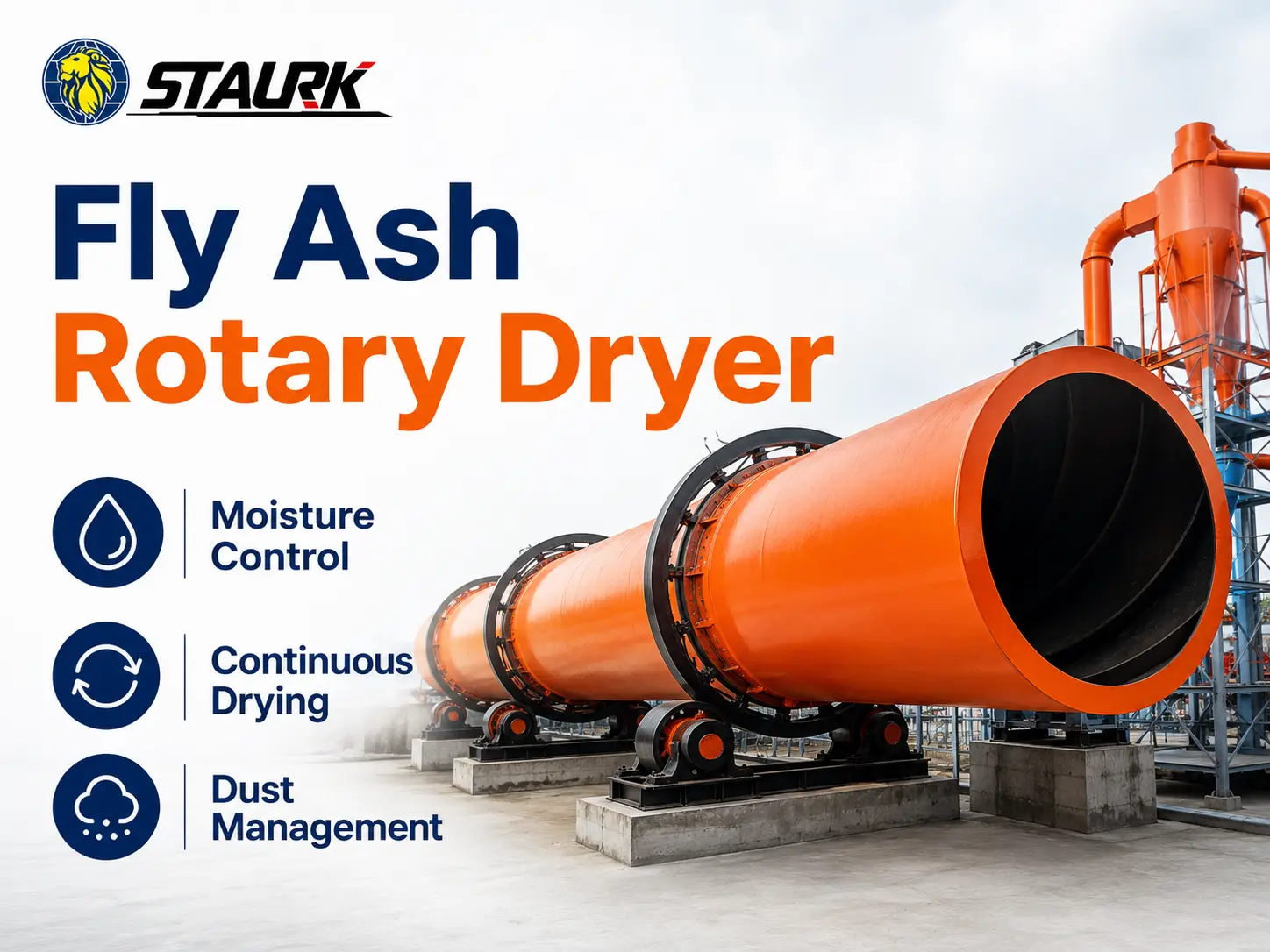
The fly ash then enters the Rotary Drum Dryer. Inside the rotating drum, the material moves gradually from the inlet to the outlet while hot air removes moisture. The drum movement helps turn and disperse the material so that drying can be more continuous.
After drying, the material may go to a storage silo, packing machine, truck loading system, or a Vibrating Screen if simple classification is needed. The final layout depends on the project target. Some customers mainly need dry fly ash for bulk storage, while others need stable material for bagging or building material production.
A complete fly ash drying plant may include feeding equipment, belt conveyor, rotary dryer, hot air system, dust collector, induced draft fan, discharge conveyor, storage silo, and control cabinet. These machines should be matched as one process, not selected separately.
Dust Control Is Not an Optional Detail
Fly ash is a fine powder material. Once dried, it can easily generate dust during discharge, conveying, screening, storage, and packing. Because of this, dust collection is one of the most important parts of a fly ash drying project.
A dryer with insufficient dust control may cause material loss, poor working conditions, and unstable plant operation. In some projects, the dust issue becomes more serious after drying because the material becomes lighter and easier to carry with air flow.
A suitable fly ash drying system usually needs a dust collection system matched with the dryer, fan, air duct, discharge point, and storage equipment. Depending on project requirements, a cyclone dust collector, bag filter, or combined dust collection system may be considered.
For buyers, this means the dryer drum size is not the only selection point. The complete air flow and dust collection design should be discussed at the same time as the fly ash rotary dryer.
What Buyers Should Confirm Before Selection
Before selecting a fly ash rotary dryer, buyers should provide more than just the required capacity. The most important information includes fly ash source, initial moisture content, required final moisture, powder fineness, lump condition, feeding method, working hours, available heat source, and downstream use.
It is also important to clarify whether the capacity refers to wet material input or dried material output. For high-moisture fly ash, the difference between wet input and dry output can be significant. If this point is not clear, the dryer may be incorrectly sized.
The heat source should also be selected according to local conditions. Coal, natural gas, diesel, biomass, or other fuels may be used depending on availability, operating cost, and environmental requirements. A stable heat source helps maintain more consistent final moisture.
For existing plant upgrades, buyers should also explain the current problem. For example, the issue may be material caking, difficult silo discharge, unstable packing, high transportation moisture, or excessive dust during handling. Different problems may require different drying plant configurations.
How Staurk Supports Fly Ash Drying Projects
Staurk does not recommend a fly ash rotary dryer only by material name. For fly ash projects, the dryer should be matched with moisture condition, powder behavior, heat source, dust collection requirement, site layout, and downstream use.
Some customers may only need one rotary dryer to improve an existing handling system. Other projects may need a complete fly ash drying plant with feeding system, Belt Conveyor, hot air furnace, Rotary Drum Dryer, dust collector, fan, storage silo, and packing equipment.
For building material producers, power plant by-product utilization projects, EPC contractors, and equipment distributors, this process-based selection can help reduce equipment mismatch and improve long-term operation stability.

A fly ash rotary dryer is useful when fly ash needs to be dried before storage, packing, transportation, screening, or building material processing. Its main value is not only moisture reduction, but also better material handling, less caking, smoother conveying, and improved process stability.
When choosing a fly ash rotary dryer, buyers should consider raw moisture, final moisture, powder fineness, lump condition, feeding method, heat source, dust collection, site layout, and downstream application. A suitable system should match the full process from wet material feeding to dried material storage or packing.
If you are planning a fly ash drying project, it is better to evaluate the dryer as part of the complete plant solution instead of selecting only by drum size or price.
If you need a fly ash rotary dryer for building material processing, storage, or packing applications, Staurk can help review your project requirements and recommend a practical drying solution. Please share your fly ash source, initial moisture content, required final moisture, powder fineness, lump condition, processing capacity, available heat source, installation site condition, dust collection requirement, and downstream use. Based on these details, Henan Staurk Machinery Co.,Ltd can provide a suitable fly ash rotary dryer recommendation and fly ash drying plant solution.